

In banking and finance, accuracy is essential. Professionals work with sensitive information, financial decisions, regulations, deadlines, and significant levels of responsibility. A small error can sometimes have consequences, so attention to detail and careful decision-making matter.
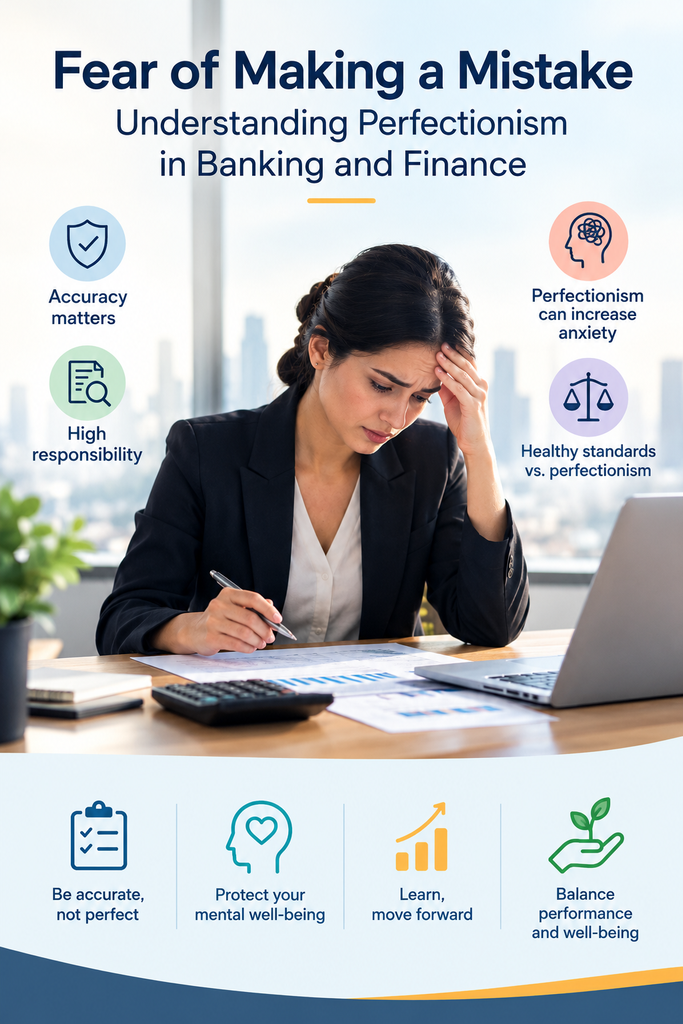
But when the fear of making a mistake becomes constant, high professional standards can turn into something more difficult: perfectionism.
Perfectionism can cause professionals to believe that mistakes are unacceptable, that their work must be flawless, or that a single error says something negative about their competence. Over time, this mindset can lead to anxiety, excessive checking, indecision, self-criticism, and burnout.
Understanding the difference between healthy attention to detail and unhealthy perfectionism can help finance professionals protect both their performance and their mental well-being.
Why perfectionism can develop in banking and finance
Banking and finance environments naturally emphasize accuracy, accountability, and risk management. Employees may prepare financial reports, review transactions, manage client accounts, assess investments, meet compliance requirements, or make decisions under time pressure.
These expectations can be useful. However, professionals who already hold extremely high expectations for themselves may begin to interpret normal human mistakes as evidence of personal failure.
For example, someone might spend excessive time checking a spreadsheet, repeatedly reread an email before sending it, delay submitting work because it does not feel perfect, or continue thinking about a minor mistake long after the workday has ended.
The issue is not caring about quality. It is when the need to avoid mistakes becomes a source of persistent distress.
Perfectionism vs. healthy high standards
High standards and perfectionism are not the same.
A professional with healthy high standards can recognize an error, correct it, learn from it, and move forward. A perfectionistic professional may struggle to let go of the mistake and repeatedly question their competence.
Common perfectionistic thoughts may include:
- “I should have caught that.”
- “If I make a mistake, people will lose confidence in me.”
- “I cannot submit this until it is completely perfect.”
- “Everyone else is better at this than I am.”
- “One mistake could damage my career.”
These thoughts can create a cycle of anxiety. Fear leads to more checking and reassurance-seeking, which may provide temporary relief but reinforce the belief that mistakes are dangerous.
How perfectionism can affect decision-making
Financial professionals frequently have to make decisions despite uncertainty. Not every situation provides complete information, and waiting for absolute certainty may not always be practical.
Perfectionism can make uncertainty particularly uncomfortable.
A person may continually search for more information, postpone a decision, repeatedly ask colleagues for reassurance, or avoid taking reasonable action because they fear choosing incorrectly.
This can affect productivity as well as confidence.
A useful distinction is between professional due diligence and anxiety-driven checking. Reviewing important work carefully is appropriate. Rechecking the same information repeatedly because it feels impossible to trust one’s own judgment is different.
Creating clear review procedures and reasonable stopping points can help professionals maintain accuracy without becoming trapped in endless checking.
The connection between perfectionism and anxiety
Perfectionism can extend beyond individual tasks. Professionals may find themselves worrying about work after hours, replaying conversations, anticipating criticism, or feeling that they are never performing well enough.
Success may provide only temporary relief because the internal standard remains extremely high.
This can gradually lead to emotional exhaustion. Instead of feeling satisfied after completing a difficult project, the person may immediately focus on what could have gone wrong or what needs to be improved next.
According to Samaneh Bayat, M.A., Registered Psychotherapist (RP) and Certified Canadian Counsellor (CCC), understanding patterns involving anxiety, mood, self-perception, and adjustment can be a key part of mental health support. Bayat is a member of the College of Registered Psychotherapists of Ontario and has provided structured psychotherapy, mental health assessment, crisis support/planning, and treatment services to adults, teenagers, couples, and families.
Her professional training includes Cognitive Behavioral Therapy (CBT), Dialectical Behavior Therapy (DBT), Emotionally Focused Therapy (EFT), Internal Family Systems (IFS), Motivational Interviewing, client-centered therapy, and Group CBT.
Changing the way mistakes are viewed
Reducing perfectionism does not mean becoming careless.
In finance, accountability still matters. The goal is to develop a healthier response when something does go wrong.
One useful starting point is separating a mistake from personal identity. Making an error does not automatically mean someone is incompetent. A mistake can be examined, corrected, and used to improve a process.
CBT, one of the therapeutic approaches in which Bayat has specialized training, can help people examine unhelpful patterns of thinking and develop more balanced responses.
For someone struggling with perfectionistic thinking, this may involve questioning assumptions such as “I must never make mistakes” or “If I make an error, everyone will think I am incapable.”
The objective is not to replace high standards with low standards. It is to create standards that are demanding without becoming psychologically overwhelming.
What employers can do
Organizations can also influence how employees experience mistakes.
Managers can encourage employees to ask questions, raise concerns, and learn from errors rather than creating a workplace where people feel they must appear flawless at all times.
Clear procedures, realistic workloads, constructive feedback, and psychologically safer communication can help employees focus on responsible performance rather than constant fear. This matters especially in high-pressure industries, where mistakes need to be addressed seriously but shouldn’t automatically become a source of shame.
When professional support may be helpful
Perfectionism is not automatically a mental health disorder. However, professional support may be worth considering when fear of mistakes begins to interfere with everyday functioning.
Warning signs can include persistent anxiety, excessive checking, avoidance of decisions, severe self-criticism, difficulty sleeping because of work-related worries, inability to switch off after work, or symptoms of burnout.
Bayat’s clinical practice includes work with anxiety and mood disorders, depression, OCD and personality disorders, trauma/PTSD, bipolar disorder, life transitions, and adjustment difficulties. Her profile also notes ongoing clinical education and more than 200 hours of volunteer mental health lectures and workshops within the Iranian community in Canada.
For someone experiencing significant distress, speaking with a qualified mental health professional can help them understand the underlying patterns and develop healthier coping strategies.
Finding the balance between accuracy and well-being
Banking and finance require professionals to be careful, responsible, and detail-oriented. Those qualities should be preserved.
But professional excellence does not require perfection.
A healthier approach recognizes that competent professionals can make mistakes, respond appropriately, learn from them, and continue performing at a high level.
The goal is not to eliminate every possibility of error. It is to build the confidence to handle uncertainty without allowing the fear of failure to control every decision.
For finance professionals who constantly feel that one mistake could undermine their worth or career, recognizing perfectionism can be an important first step toward a more sustainable relationship with work, achievement, and self-confidence.