

When Helping Others Comes at a Personal Cost
Every morning across the Greater Toronto Area (GTA), thousands of professionals begin their day carrying responsibilities that extend far beyond their job descriptions.
Teachers step into classrooms ready to educate, mentor, manage behavior, support mental health needs, and help shape the future of their students. At the same time, banking and financial services professionals in Toronto’s Financial District prepare to navigate complex markets, meet demanding performance targets, support anxious clients, and make high-stakes financial decisions.
Both careers are deeply meaningful. Both contribute significantly to the well-being and success of communities across Ontario.
Yet behind the professionalism and dedication lies a growing mental health challenge.
As we move through 2026, burnout continues to affect workers across Canada at concerning levels. Research consistently shows that high-stress professions experience some of the highest rates of emotional exhaustion, chronic stress, anxiety, and work-life imbalance. Teachers and finance professionals are among the groups most impacted.
The lingering effects of post-pandemic recovery, ongoing housing affordability concerns, economic uncertainty, staffing shortages, and increasing workplace demands have created an environment where many dedicated professionals are running on empty.
Fortunately, more educators and finance professionals are recognizing that therapy is not a last resort—it is a proactive investment in resilience, emotional well-being, and long-term success.
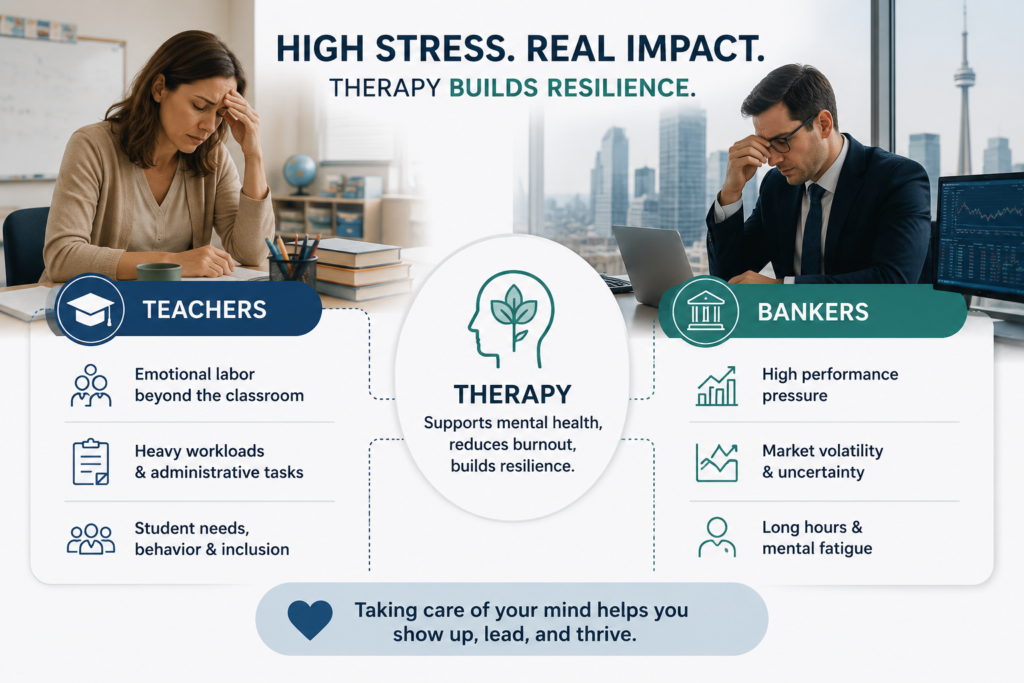
The High-Stress Landscape for GTA Teachers
Teaching has always required patience, compassion, and adaptability. However, the realities facing Ontario educators in 2026 have added layers of complexity that many professionals never anticipated when entering the field.
Emotional Labor Beyond the Curriculum
Today’s teachers are expected to do far more than deliver academic instruction.
Many GTA educators regularly support students experiencing:
- Mental health challenges
- Family instability
- Social and emotional difficulties
- Learning differences
- Behavioral concerns
- Technology-related distractions
While rewarding, this emotional labor can become overwhelming when sustained over months and years.
Teachers often spend their days caring for others while neglecting their own emotional needs.
Administrative Burdens Continue to Grow
Many educators report spending substantial time outside regular school hours on:
- Lesson planning
- Assessment and grading
- Documentation requirements
- Parent communication
- Professional development
- Individualized student support plans
For many, evenings and weekends no longer feel like personal time.
The result is a persistent sense of being “always on.”
Student Behavioral Challenges and Inclusion Pressures
Across Ontario, teachers are increasingly navigating diverse classroom needs while often feeling they lack sufficient support and resources.
Managing behavioral issues, supporting inclusive learning environments, and addressing varying academic needs simultaneously can contribute significantly to workplace stress.
Teacher Shortages and Retention Challenges
Ontario continues to face teacher retention concerns in several regions and specialties.
Staff shortages often lead to:
- Larger workloads
- Reduced preparation time
- Increased classroom complexity
- Higher stress levels for existing staff
Canadian studies have consistently found elevated emotional exhaustion rates among educators, with many reporting significantly higher workplace stress than the general population.
The consequence is a growing number of talented professionals questioning whether they can sustainably remain in the profession they once loved.
Pressures Facing Bankers and Finance Professionals in Toronto
While teachers face challenges inside classrooms, finance professionals face a different—but equally demanding—set of pressures.
Toronto remains Canada’s financial capital, and the city’s banking and financial services sector is known for its high-performance culture.
Constant Performance Expectations
Many banking professionals work in environments where success is measured through:
- Revenue targets
- Sales goals
- Client acquisition
- Portfolio growth
- Regulatory compliance
- Productivity metrics
These expectations create ongoing pressure to perform at consistently high levels.
For commission-based and performance-driven roles, financial outcomes are often directly tied to compensation, adding another layer of stress.
Market Volatility and Economic Uncertainty
The financial sector has experienced continued volatility throughout recent years.
Professionals regularly manage:
- Interest rate fluctuations
- Market uncertainty
- Economic forecasts
- Investment concerns
- Changing regulations
The responsibility of helping clients navigate uncertainty can create substantial emotional strain.
Client Anxiety Has Become Part of the Job
Many clients entering banks and financial institutions today are experiencing their own financial stress.
Housing affordability concerns, retirement planning uncertainty, inflation pressures, and debt management challenges often become part of everyday conversations.
Professionals frequently absorb the emotional impact of these concerns.
In many cases, client stress related to housing affordability, mortgage decisions, and market uncertainty mirrors the anxiety seen in GTA real estate markets discussed in TRREB and CMHC outlooks.
Long Hours and Mental Fatigue
Banking professionals often face:
- Extended workdays
- High cognitive demands
- Continuous decision-making
- Constant connectivity
- Limited recovery time
Over time, chronic mental fatigue can reduce productivity, impair judgment, and increase vulnerability to burnout.
Why Teachers and Bankers Are Particularly Vulnerable to Burnout
Although educators and finance professionals work in very different industries, they share several important risk factors.
Emotional Exhaustion
Both professions involve significant emotional investment.
Teachers support students and families.
Bankers support clients navigating important financial decisions.
Over time, continuously giving emotional energy without adequate replenishment can lead to exhaustion.
Depersonalization
One hallmark of burnout is depersonalization—the feeling of becoming emotionally detached from work and the people being served.
Professionals may begin to feel:
- Cynical
- Disconnected
- Less empathetic
- Emotionally numb
This can be particularly distressing for individuals who entered their professions because they genuinely care about helping others.
Work-Life Imbalance
Many professionals struggle to create healthy separation between work and personal life.
Without boundaries, stress begins affecting:
- Sleep quality
- Physical health
- Relationships
- Family life
- Career satisfaction
Reduced Decision-Making Capacity
Chronic stress impairs concentration, memory, and problem-solving abilities.
Whether managing a classroom or advising clients on financial matters, clear thinking becomes more difficult when burnout takes hold.
The Transformative Role of Therapy
One of the most encouraging developments in recent years is the growing recognition that therapy can be a powerful tool for professional resilience.
Therapy is not simply about treating symptoms.
It helps individuals develop sustainable strategies for thriving under pressure.
Improved Emotional Regulation
High-stress professionals often spend much of their day managing external demands.
Therapy creates space to process emotions, reduce overwhelm, and develop healthier coping mechanisms.
Burnout Prevention Rather Than Burnout Recovery
Many people seek support only after reaching a breaking point.
Therapy can help identify warning signs early, allowing individuals to address stress before it becomes debilitating.
Stronger Boundaries
Professionals frequently struggle with saying no, disconnecting after work, or prioritizing self-care.
Therapeutic support helps individuals establish healthier boundaries while maintaining professional effectiveness.
Reduced Anxiety and Catastrophic Thinking
Evidence-based approaches such as Cognitive Behavioural Therapy (CBT) help individuals challenge unhelpful thought patterns and develop more balanced perspectives.
Instead of becoming trapped in cycles of worry, clients learn practical strategies for responding to challenges with clarity.
Enhanced Resilience
Resilience is not about avoiding stress.
It is about developing the capacity to recover, adapt, and continue moving forward despite challenges.
Therapy helps strengthen this capacity through increased self-awareness, emotional flexibility, and self-compassion.
Personalized Support at Wellness Experts in Thornhill
For educators, banking professionals, and other high-performing individuals seeking support, Wellness Experts offers personalized psychotherapy and holistic mental health services designed to meet the realities of modern professional life.
Conveniently located at 100 Steeles Ave W, Thornhill, ON, Wellness Experts serves clients throughout Toronto, Vaughan, Markham, Richmond Hill, and the wider GTA.
The clinic is led by Samaneh Bayat, RP, CCC, Clinical Director and psychotherapist with Master’s degrees from York University and Yorkville University.
Her expertise includes:
- Cognitive Behavioural Therapy (CBT)
- Dialectical Behaviour Therapy (DBT)
- Emotionally Focused Therapy (EFT)
- Internal Family Systems (IFS)
- Trauma-informed psychotherapy
- Integrative mind-body approaches
Rather than applying a one-size-fits-all model, Wellness Experts develops personalized treatment plans tailored to each client’s unique goals, challenges, and life circumstances.
This holistic philosophy recognizes that stress affects both mind and body and that meaningful healing requires addressing the whole person.
For busy professionals navigating demanding careers, this personalized approach can provide practical tools for managing stress while fostering lasting personal growth.
Practical Strategies for Managing Stress in 2026
While therapy offers valuable professional support, daily habits also play an important role in protecting mental health.
Consider these strategies:
1. Create Clear Boundaries
Establish dedicated times when work emails, messages, and tasks are paused.
2. Prioritize Recovery
Rest is not a luxury—it is a requirement for sustainable performance.
3. Stay Connected
Supportive relationships remain one of the strongest protective factors against burnout.
4. Practice Mindfulness
Even five minutes of intentional breathing or reflection can help regulate stress levels.
5. Seek Support Early
You do not need to wait until stress becomes overwhelming.
Early intervention often leads to better outcomes and faster recovery.
Investing in Your Well-Being Is Investing in Your Future
Teachers shape the next generation. Bankers and financial professionals help individuals, families, and businesses build financial security.
These professions matter deeply.
But the people performing them matter just as much.
If chronic stress, emotional exhaustion, or burnout are beginning to affect your health, relationships, or career satisfaction, know that support is available.
At Wellness Experts, GTA professionals receive compassionate, evidence-based care designed to help them regain balance, build resilience, and thrive both personally and professionally.
Whether you are searching for psychotherapy in Toronto, teacher burnout support in the GTA, stress management for bankers, or holistic mental health care in Thornhill, taking the first step toward support can be one of the most important investments you make in yourself.
Learn more or book a consultation by visiting https://wellnessexperts.ca/ and discover how personalized therapy can help you build a healthier, more resilient future.