

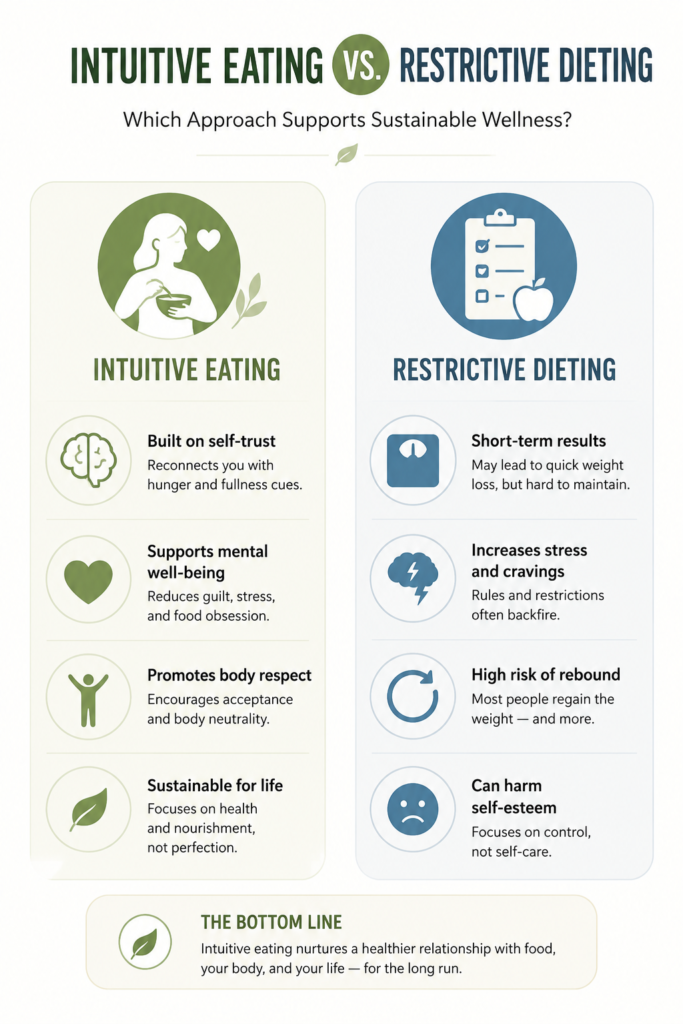
If you’ve ever finished a diet only to gain the weight back — plus a little more — you’re not alone, and you’re not “doing it wrong.” Research consistently shows that the majority of people who lose weight through calorie-restrictive dieting regain it within a few years, often triggering a frustrating cycle of loss and regain known as weight cycling. At the same time, a growing body of evidence points to intuitive eating as a sustainable, weight-inclusive alternative that prioritizes long-term physical and mental health over short-term numbers on a scale.
At Wellness Expert, our team of wellness professionals works with clients across Canada who are exhausted by yo-yo dieting and looking for an approach that actually lasts. This guide breaks down both philosophies — intuitive eating and restrictive dieting — using the latest research, so you can make an informed, personalized decision about what’s right for your body and your life.
What Is Intuitive Eating?
Intuitive Eating (IE) is an evidence-based, weight-inclusive framework developed in 1995 by two American registered dietitians, Evelyn Tribole, MS, RDN, CEDRD-S, and Elyse Resch, MS, RDN, CEDRD. Rather than a diet plan with rules, IE is a self-care framework that integrates instinct, emotion, and rational thought to help people rebuild trust in their body’s internal hunger, fullness, and satisfaction cues.
The 10 Principles of Intuitive Eating
Tribole and Resch organized IE into ten core principles. These aren’t rigid rules, but flexible guidelines:
- Reject the Diet Mentality — Let go of the belief that a new diet, cleanse, or food plan is the answer. Diet culture keeps people trapped in a cycle of hope and failure.
- Honor Your Hunger — Keep your body adequately fueled so you don’t trigger a primal urge to overeat once you finally do eat.
- Make Peace with Food — Give yourself unconditional permission to eat; labeling foods “good” or “bad” often fuels cravings and bingeing.
- Challenge the Food Police — Quiet the inner critic that assigns guilt or shame to food choices.
- Discover the Satisfaction Factor — Find pleasure and contentment in eating experiences, which helps you naturally eat an appropriate amount.
- Feel Your Fullness — Tune in to body signals that indicate comfortable fullness, and pause to check in mid-meal.
- Cope with Your Emotions with Kindness — Find non-food ways to soothe, distract, or comfort yourself emotionally.
- Respect Your Body — Accept your genetic blueprint rather than expecting your body to conform to an unrealistic size or shape.
- Movement — Feel the Difference — Shift focus from calorie-burning to how movement makes you feel energetically.
- Honor Your Health with Gentle Nutrition — Make food choices that honor your health and taste buds while making you feel good, without needing to be “perfect.”
That last principle, gentle nutrition, is often misunderstood. It’s the piece that distinguishes IE from simply “eating whatever you want” — it invites nutritional knowledge back into the picture, but only once a person’s relationship with food and body has stabilized, and always without judgment or rigidity.
Today, IE researchers report more than 100 published studies examining its outcomes, and a validated psychometric tool (the Intuitive Eating Scale) is used to measure it in clinical and academic settings.
What Is Restrictive Dieting?
Restrictive dieting refers to any structured eating approach centered on calorie restriction or the elimination of specific foods or food groups to control weight. Common forms include:
- Calorie-counting diets (e.g., strict daily calorie targets)
- Low-carbohydrate or ketogenic diets
- Intermittent fasting with rigid eating windows
- Elimination diets not medically indicated (e.g., cutting out entire food groups without an allergy or intolerance)
- Very-low-calorie meal replacement programs
These approaches can produce short-term weight loss, and in supervised clinical contexts (such as for individuals with obesity-related metabolic disease), structured calorie restriction can be medically appropriate. The concern from a sustainability standpoint is what tends to happen afterward.
The Weight Cycling Problem
Most people who lose weight through restrictive dieting regain a significant portion of it within one to five years. When this loss-and-regain pattern repeats, it’s called weight cycling or “yo-yo dieting.” Recent research raises real concerns about this pattern:
- A 2024 cardiometabolic study published in Obesity (Swartz et al.) found that people with a history of weight cycling had worse blood glucose, lower HDL (“good”) cholesterol, and higher triglycerides than weight-stable individuals — despite being younger and having similar starting BMI.
- A 2024 review in Current Obesity Reports (Sanaya, Janusaite, Dalamaga & Magkos) synthesizing the physiological evidence noted that two recent meta-analyses found weight cycling was associated with greater pooled risk of type 2 diabetes, cardiovascular disease, and all-cause mortality, even though findings across individual studies are mixed.
- A 2026 clinical perspective in The Lancet Diabetes & Endocrinology examined whether weight cycling is clinically harmful, pointing to emerging mechanistic evidence — including research on “adipose tissue memory” — suggesting the body may retain metabolic imprints of past weight fluctuations.
None of this means restrictive dieting is inherently dangerous for everyone, or that intentional, medically supervised weight management is off the table. But it does mean the sustainability of restrictive approaches deserves honest scrutiny — something diet culture rarely provides.
Intuitive Eating vs. Restrictive Dieting: A Side-by-Side Look
| Factor | Intuitive Eating | Restrictive Dieting |
|---|---|---|
| Primary goal | Food freedom, body trust, overall well-being | Weight loss via calorie/food control |
| Structure | Flexible principles, self-directed | Fixed rules, external structure |
| Weight outcomes | Weight-neutral; weight change is not tracked as success | Often effective short-term; high regain rates long-term |
| Psychological effects | Associated with lower depression, anxiety, and disordered eating; improved body image | Can increase preoccupation with food, guilt, and binge-eating risk with prolonged restriction |
| Metabolic health | Improvements in cholesterol and blood glucose reported in some trials, independent of weight change | Short-term metabolic improvement common; weight cycling linked to insulin resistance and cardiometabolic risk over time |
| Sustainability | Designed as a long-term lifestyle, not a temporary intervention | Frequently unsustainable beyond months; adherence drops over time |
| Risk profile | Generally low risk; caution needed for those in active eating disorder recovery (should be guided by a specialist) | Can trigger disordered eating patterns and weight cycling in susceptible individuals |
What the Research Says About Outcomes
A 2023 systematic review and meta-analysis published in Eating Disorders (Babbott, Cavadino, Brenton-Peters, Consedine & Roberts) aggregated intuitive eating intervention studies and found IE approaches were associated with improvements in eating behavior and psychological well-being, while noting that robust, large-scale randomized trials are still needed — a fair and balanced caveat worth repeating here.
Separately, Harvard’s Nutrition Source summarizes a randomized controlled trial comparing a calorie-restricted weight-loss program to a weight-neutral intuitive eating program in women aged 30–45. Both groups improved quality of life, self-esteem, and cholesterol markers over two years, but the weight-neutral group showed greater reductions in LDL cholesterol — without ever targeting weight loss directly.
Harvard also references a meta-analysis of 10 randomized controlled trials comparing conventional calorie-restriction weight-loss programs to mindful/intuitive eating strategies, which found intuitive/mindful approaches were effective for weight loss compared to no intervention, with no significant difference in weight loss compared to conventional dieting — but with the added psychological benefits IE tends to produce.
Broader research consistently links intuitive eating to lower rates of depression, anxiety, and disordered eating symptoms, and higher body appreciation, according to multiple meta-analyses on IE’s psychological correlates.
Which Approach Is Right for You?
There’s no single answer that fits everyone — and at Wellness Experts, we intentionally avoid one-size-fits-all prescriptions. Consider these factors:
Intuitive eating may be a good fit if you:
- Have a history of chronic dieting, weight cycling, or disordered eating patterns
- Feel mentally preoccupied with food, calories, or “good vs. bad” eating
- Are looking for a sustainable, long-term relationship with food rather than a short-term fix
- Have already ruled out (or are managing) underlying medical conditions with a healthcare provider
A more structured, medically guided approach may be appropriate if you:
- Have a diagnosed medical condition (e.g., type 2 diabetes, insulin resistance) where a registered dietitian or physician recommends specific nutritional structure
- Are training for a specific athletic or performance goal requiring precise fueling
- Prefer more external structure as a personality trait, provided it doesn’t tip into rigidity or restriction-driven distress
Many people benefit from a hybrid approach
In practice, plenty of individuals blend IE’s philosophy — body trust, rejecting food guilt, tuning into hunger and fullness — with gentle nutrition guidance informed by resources like Canada’s Food Guide, which itself has moved toward a flexible, whole-foods, plate-based model rather than rigid calorie prescriptions. This hybrid approach lets people honor nutritional knowledge without falling back into diet mentality.
How to Start Practicing Intuitive Eating (or a Gentle Hybrid)
If you’re ready to explore intuitive eating, here’s where our team suggests starting:
1. Practice mindful eating exercises
- Eat one meal a day without screens, rating your hunger before and fullness after on a 1–10 scale.
- Pause halfway through a meal and ask: How does this taste? How full am I?
2. Rebuild meals around gentle nutrition, not rules
Sample gentle-nutrition meal framework (not a meal plan — just a flexible template):
- Breakfast: Greek yogurt, berries, and a drizzle of honey, paired with whatever satisfies you that morning
- Lunch: A grain bowl with a protein, vegetables, and a fat source (olive oil, avocado, nuts) — built around what sounds good, not what’s “allowed”
- Dinner: A balanced plate loosely inspired by Canada’s Food Guide’s proportions — half vegetables/fruit, a quarter protein, a quarter whole grains — adjusted to appetite, not a fixed portion size
3. Reconnect with joyful movement
Choose activity based on how it makes you feel, not calories burned — a walk with a podcast, a dance class, a recreational sport.
4. Work with a registered dietitian (RD)
An RD trained in non-diet approaches or Intuitive Eating counseling can help you personalize principles like gentle nutrition, especially if you have a chronic condition, are recovering from an eating disorder, or simply want tailored support.
Potential Pitfalls and When to Seek Professional Help
Intuitive eating is not risk-free for everyone, and restrictive dieting is not universally harmful — context matters enormously.
- If you have a history of disordered eating or an active eating disorder, self-directed intuitive eating without professional guidance can sometimes be destabilizing. Work with a therapist and RD who specialize in eating disorders.
- If you have a diagnosed metabolic condition, don’t discontinue a physician-recommended nutrition plan without medical guidance.
- If restrictive dieting is causing significant psychological distress, obsessive food thoughts, or patterns of bingeing and restricting, this may be a sign to speak with a healthcare provider — this pattern is associated with a higher likelihood of disordered eating.
- Watch for red flags such as skipping meals to “make up for” eating, intense guilt after eating, or exercise used purely as punishment. These warrant a conversation with a professional, not more willpower.
If any of this resonates with you, please reach out to a registered dietitian, physician, or mental health professional. This article is educational and is not a substitute for individualized care.
The Bottom Line
Both intuitive eating and restrictive dieting have a place in the nutrition landscape — but for most people seeking sustainable wellness rather than a quick fix, the research increasingly favors approaches that prioritize long-term psychological and metabolic health over short-term weight loss. Intuitive eating, grounded in Evelyn Tribole and Elyse Resch’s 10 principles, offers a research-backed, weight-inclusive path away from the exhausting cycle of restriction, weight loss, and regain.
At Wellness Expert, our team of wellness professionals believes health is personal — not a one-size-fits-all number on a scale. If you’re in Thornhill, ON, or anywhere across Canada, and you’re ready to build a sustainable, evidence-based approach to eating that actually fits your life, we’re here to help.
Ready to find your personalized approach to sustainable wellness? Book a consultation with our team or subscribe to our newsletter for more evidence-based wellness guidance.
Sources & Further Reading
- Babbott, K. M., Cavadino, A., Brenton-Peters, J., Consedine, N. S., & Roberts, M. (2023). Outcomes of intuitive eating interventions: A systematic review and meta-analysis. Eating Disorders, 31(1), 33–63. https://doi.org/10.1080/10640266.2022.2030124
- Harvard T.H. Chan School of Public Health. The Nutrition Source: Intuitive Eating. https://www.hsph.harvard.edu/nutritionsource/intuitive-eating/
- Harvard T.H. Chan School of Public Health. The Nutrition Source: Mindful Eating. https://nutritionsource.hsph.harvard.edu/mindful-eating/
- Tribole, E., & Resch, E. 10 Principles of Intuitive Eating. Intuitive Eating. https://www.intuitiveeating.org/10-principles-of-intuitive-eating/
- Intuitive Eating. Definition of Intuitive Eating. https://www.intuitiveeating.org/definition-of-intuitive-eating/
- Swartz, S. R., et al. (2024). Cardiometabolic characteristics of weight cycling: Results from a mid-South regional comprehensive health care system. Obesity, 32(11), 2045–2059. https://doi.org/10.1002/oby.24163
- Sanaya, N., Janusaite, M., Dalamaga, M., & Magkos, F. (2024). The physiological effects of weight-cycling: A review of current evidence. Current Obesity Reports, 13(1), 35–50. https://doi.org/10.1007/s13679-023-00539-8
- Is weight cycling clinically harmful? (2026). The Lancet Diabetes & Endocrinology. https://www.thelancet.com/journals/landia/article/PIIS2213-8587(26)00037-9/abstract
- Government of Canada. Canada’s Food Guide. https://food-guide.canada.ca/
- Talkspace. (2020). Intuitive Eating: Interview with Evelyn Tribole and Elyse Resch. https://www.talkspace.com/blog/intuitive-eating-interview-mindfulness-with-evelyn-tribole-and-elyse-resch/